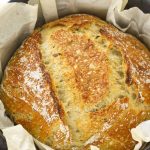
No-Knead Rosemary Bread
An easy No-Knead Rosemary Bread baked in a Dutch oven. This is a large, lofty loaf of artisan-style bread with a crunchy crust, a moist crumb that is infused with fresh rosemary leaves.
Servings: 1 loaf
Ingredients
- 4½ cups all-purpose flour or bread flour, 540 grams
- 1½ packet Quick Rise Instant yeast 11 grams or 3 teaspoons
- 2 teaspoons salt 9 grams
- 4 tablespoons fresh rosemary divided
- 2¼ cups water lukewarm; up to 120°F, (338 grams)
Instructions
- Fluff up the flour before measuring or weighing; then add the flour, yeast, salt to a mixing bowl and stir to combine.
- Chop 1 tablespoon of the rosemary leaves and add them along with the whole leaves to the flour mixture, stir to combine.
- Make a well in the center of the flour mixture and pour the water in, stir to combine and no flour remains on the bottom of the bowl. The dough will be soft and sticky.
- Coat a large bowl with olive or vegetable oil; then transfer the dough into the bowl. (See Notes).
- Cover the bowl with a piece of oil-sprayed plastic wrap or parchment paper. Let rise for 1 hour in a warm area of the kitchen.
- When the dough has been rising for 40 minutes, place a 6-quart Dutch oven, with its lid, into the oven and set the oven temperature to 450°F.
- After the dough has risen for the full 1 hour, sift a light dusting of flour on a large piece of parchment paper and set aside.
- Tip the dough out onto a lightly flour-dusted surface. Use a bench scraper or spatula to turn and fold the dough 5 or 6 times to shape into a rough mound. Dust lightly with flour.
- Place the dough, folded side down, in the center of the reserved parchment paper. Dust the top of the mound lightly with flour.
- Using the parchment paper as a sling, lift the dough and set it into another bowl, cover with plastic wrap and let rise for 30 minutes (see Notes).
To Bake the Bread:
- Carefully transfer the hot Dutch oven from the oven to the countertop and remove the lid.
- Remove the plastic wrap from the dough. With a sharp knife, scissors or a bread taser blade, score the bread dough on the top with a slash or X, (see Notes).
- Again, using the parchment paper as a sling, lift the dough and carefully set it into the hot Dutch oven.
- Place the lid on the Dutch oven and transfer to the oven.
- Bake for 45 minutes, then remove the lid from the Dutch oven and bake the bread for an additional 12 to 15 minutes.
- Transfer the hot Dutch oven to the work area and using the parchment paper, lift the bread out and place on a wire rack. Let cool before slicing.
Notes
Bread flour: Bread flour generally has more protein than all-purpose flour and may absorb more water. If the dough seems dry, add 2 tablespoons of water, then add more as needed, up to ¼ cup total. The dough should be soft and sticky.
Yeast: Check the expiration date on the package, and store yeast in the refrigerator or freezer to keep it fresh.
Rise times: We use RapidRise or Quick Rise yeast for a faster rise. If using regular instant yeast, allow approximately 3 hours for the first rise and 1 hour for the second rise. Times can vary depending on the temperature of your kitchen.
Mixing and rising: You can mix the dough and let it rise in the same bowl. Transferring it to an oiled bowl is optional, but it makes the sticky dough easier to turn out onto the work surface.
Shaping: Place the shaped dough and parchment paper in a bowl for the final rise. The bowl helps the dough hold its shape.
Scoring: Scoring the top is optional, but it gives the dough room to expand as it bakes.
Misting: For extra steam, lightly mist the top of the dough with water before placing it in the oven. This can help the loaf expand as it bakes.
Dutch oven: The lid traps steam, helping the bread rise and develop a crisp crust. Remove the lid for the final portion of baking so the crust doesn’t become too thick.
Checking for doneness: The bread should sound hollow when tapped on the bottom. For a more reliable check, insert an instant-read thermometer into the center of the loaf; it should register 210°F.
Nutrition
Serving: 1 | Calories: 79kcal | Carbohydrates: 16g | Protein: 2g | Sodium: 238mg | Fiber: 1g
